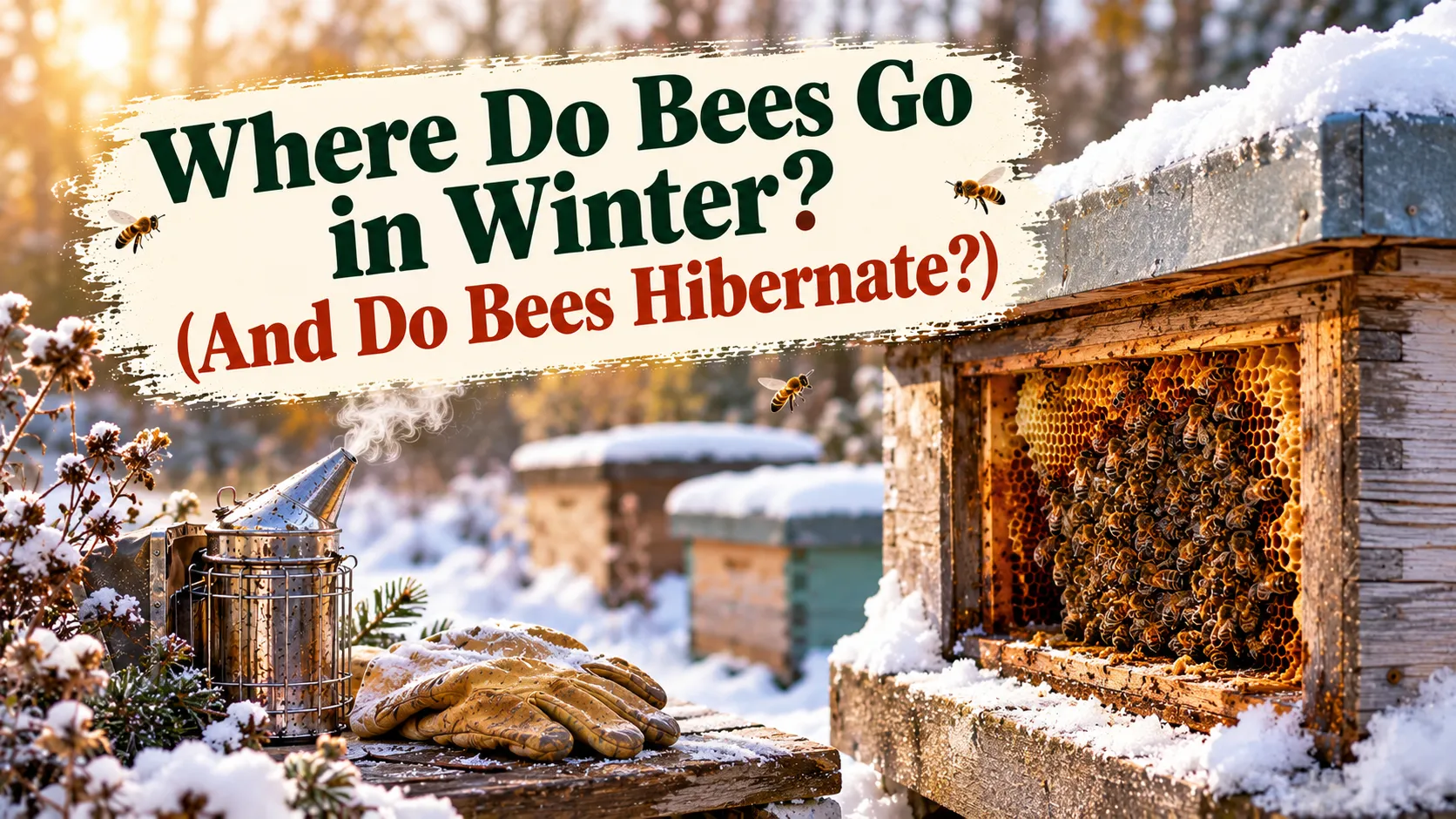
On a cold January day you won’t see many bees, but most of them are still alive. Where they are and how they survive depends on which kind of bee you mean. The questions people search for, like “do bees hibernate?” or “do bees die in winter?”, have different answers for honey bees, bumble bees, and the thousands of solitary bee species in North America.
Do bees hibernate?
Honey bees: no. A honey bee colony stays awake all winter. The bees cluster together, generate heat by shivering their flight muscles, and eat the honey they stored in summer and fall. That’s why honey bees make honey in the first place: it’s their winter fuel.
Bumble bees: in a sense, yes, but only the queens. A bumble bee colony dies off in fall. Before it does, it raises new queens, which mate and then spend the winter alone in a dormant, hibernation-like state underground.
Solitary bees: in a sense, yes. Most solitary bees live as adults for only a few weeks a year. The rest of the year, including winter, the next generation rests inside sealed nest cells, often as a fully fed larva or a pupa, and emerges in spring or summer.
Where do honey bees go in winter?
Honey bees stay home. According to the University of Georgia, honey bees head back inside the hive once temperatures fall below about 40 to 50°F. From late fall until spring, the colony lives inside the hive as a winter cluster.
How the winter cluster works
As it gets colder, the bees pull together into a ball around the queen, covering several frames of comb. The bees in the center shiver their flight muscles without moving their wings, which makes heat. UGA notes that the inside of the cluster can reach up to 95°F, while the outside layer stays close to the temperature around it.
The outer bees pack tightly together, heads facing inward. Research by Derek Mitchell, published in 2023 in the Journal of the Royal Society Interface, found that the center of the cluster produces almost all of its heat. Bees on the outer edge must stay above about 50°F (10°C). If they get colder than that, they need to move inward, or they become too cold to move and fall from the cluster.
The cluster isn’t fixed in place. It drifts slowly across the comb as the bees eat the honey around them, usually moving upward. On very cold days the bees pull tighter to hold heat, and on milder days the cluster loosens.
Winter bees: the long-lived generation
The honey bees that survive winter aren’t the same as the summer workers. In late summer and fall, colonies raise a special generation called winter bees (sometimes called diutinus bees, from the Latin for “long-lasting”).
Summer workers usually live about 4 to 6 weeks, because foraging wears them out. Winter bees can live up to about 8 months, long enough to carry the colony from fall to spring, according to a 2025 study of winter bee aging.
The difference comes down to body chemistry. Winter bees have large fat bodies and high levels of vitellogenin, a storage protein that supports their long lives. That’s also part of why varroa mites are so damaging. A 2019 study in PNAS found that varroa mites feed mainly on the fat body tissue that winter bees depend on.
What honey bees eat in winter
They eat honey, and a lot of it. A colony burns its stored honey all winter to fuel the cluster’s shivering. That’s why beekeepers leave enough honey in the hive in fall. In cold northern states, a colony may need roughly 75 to 90 pounds to get through winter. Our guide to getting colonies through winter explains how beekeepers check stores and what they feed if a colony runs short.
Cleansing flights on warm days
Honey bees don’t defecate inside the hive. Instead, they hold it in until a mild, sunny day, then fly out briefly on what beekeepers call cleansing flights. If you see bees buzzing around a hive entrance on a warm winter afternoon, that’s usually what they’re doing.
What happens to drones and the queen?
Drones (male honey bees) don’t survive winter. They don’t forage or help heat the cluster, so in fall the workers stop feeding them and push them out of the hive. The queen stays at the center of the cluster, where it’s warmest. She usually stops laying eggs or lays very few in early winter, then starts laying again in late winter as the colony prepares for spring.
Where do bumble bees go in winter?
Bumble bees take a completely different approach. According to the Xerces Society, a bumble bee colony lasts only one season. In late summer and fall it stops producing workers and raises males and new queens. The males die within a few weeks after mating, and the old queen and her workers die off as the weather turns cold.
The newly mated queens are the only bumble bees that survive winter. After mating, each queen feeds heavily to build up fat reserves, then finds a place to overwinter. When researchers have found overwintering queens, they were usually a few inches underground or under leafy debris in a forest, often on north-facing slopes. A north-facing slope may help keep a queen from waking too early on a warm winter day.
In spring, each queen wakes up, feeds on early flowers, and looks for a nest site to start a new colony on her own.
Where do solitary bees go in winter?
Most of North America’s roughly 4,000 native bee species are solitary. Each female builds and stocks her own nest, then dies. The USDA’s National Agroforestry Center notes that most solitary bees are active as adults for only a few weeks a year. The rest of the year they’re inside sealed cells in underground or plant-tunnel nests. About 70 percent of native bee species nest in the ground, and about 30 percent nest in tunnels in wood or stems.
What stage they spend winter in depends on the species:
- Leafcutter bees overwinter in the nest as fully fed larvae and pupate in early spring.
- Blue orchard (mason) bees overwinter as fully formed adults inside their cocoons, ready to emerge on the first warm spring days.
- Many ground-nesting bees overwinter as larvae or pupae in cells underground.
The adults you see in spring are a new generation that has never seen the outside world.
Do bees die in winter?
Some do, and some are meant to:
- Honey bee workers die gradually through winter as they age. A healthy colony shrinks over the winter and then rebuilds in spring.
- Whole honey bee colonies can die too. In the 2025–2026 Apiary Inspectors of America survey, US beekeepers reported losing about 30% of their colonies over the winter. Common causes include varroa mites and the viruses they spread, starvation, and colonies that are too small to stay warm.
- Bumble bee colonies always die in fall, except for the new queens.
- Adult solitary bees die after their short active season, leaving their offspring in the nest.
So bees don’t simply freeze to death in winter. A healthy honey bee colony can survive weather far below freezing, because the cluster makes its own heat. Colonies that die in winter usually had problems going into it.
When do bees come back in spring?
Honey bees start flying regularly when spring temperatures rise and the first flowers bloom, such as maples, willows, and early spring bulbs. Inside the hive, colonies often start raising brood again in late winter, well before you see much activity outside.
Bumble bee queens are among the first bees out in early spring, flying low and searching for nest sites. Solitary bees emerge on a schedule that depends on the species, from early spring (mason bees) to summer (many leafcutter bees).
How you can help bees in winter
Gardeners and homeowners:
- Leave some stems and leaf litter standing over winter. Many solitary bees nest in hollow stems, and bumble bee queens may overwinter in leafy debris.
- Delay heavy fall cleanup and tilling where you can, and leave bare, undisturbed patches of soil for ground-nesting bees.
- Mow late. The USDA’s agroforestry guidance recommends mowing in late fall or winter, after colonies have died back and when queens are dormant.
- Plan early blooms. Early-flowering shrubs and bulbs feed bees when they first emerge in spring.
Beekeepers: your job in winter is to make sure the colony has enough honey, stays dry, and went into winter with low mite levels. Our guide to winter beekeeping covers stores, ventilation, and emergency feeding. If you’re thinking about keeping bees, start with our beginner’s guide to beekeeping.
Common questions
How cold is too cold for bees?
Individual honey bees can’t fly once they get too cold, and bees on the outside of a winter cluster need to stay above about 50°F (10°C). A healthy colony can survive weather far below freezing because the cluster makes its own heat. The risk comes from long cold snaps that keep the cluster from reaching its honey.
Does the queen bee survive winter?
Yes. A honey bee queen spends winter at the warm center of the cluster. For bumble bees, the old queen dies in fall, and only newly mated queens survive winter, alone underground.
Do drones survive winter?
No. In fall, honey bee workers stop feeding drones and push them out of the hive, because drones don’t forage or help keep the cluster warm. The colony raises new drones in spring.
Can bees freeze to death?
A single bee that gets separated from the cluster can chill and die. A healthy colony rarely freezes, though. Winter colony deaths are more often linked to varroa mites, starvation, moisture, or a colony too small to stay warm.
Do bees sleep in winter?
Honey bees don’t sleep through winter. They stay active inside the cluster, rotating between the warm center and the cooler outside. Bumble bee queens and many solitary bees do spend winter in a dormant state.
Sources and further reading
- UGA CAES Field Report, Where do bees go in the winter?
- Mitchell (2023), Honeybee cluster: not insulation but stressful heat sink, Journal of the Royal Society Interface
- Neuronal Plasticity in the Mushroom Bodies of Winter Bees Is Retained Despite Substantially Advanced Age (2025), PMC
- Ramsey et al. (2019), Varroa destructor feeds primarily on honey bee fat body tissue and not hemolymph, PNAS
- Xerces Society, Bumble bees: nesting and overwintering
- USDA National Agroforestry Center, Agroforestry Note 34: Enhancing nest sites for native bee crop pollinators
- NatureServe, Conservation and Management of North American Leafcutter Bees
- Apiary Inspectors of America, 2025–2026 US Beekeeping Survey (preliminary results)