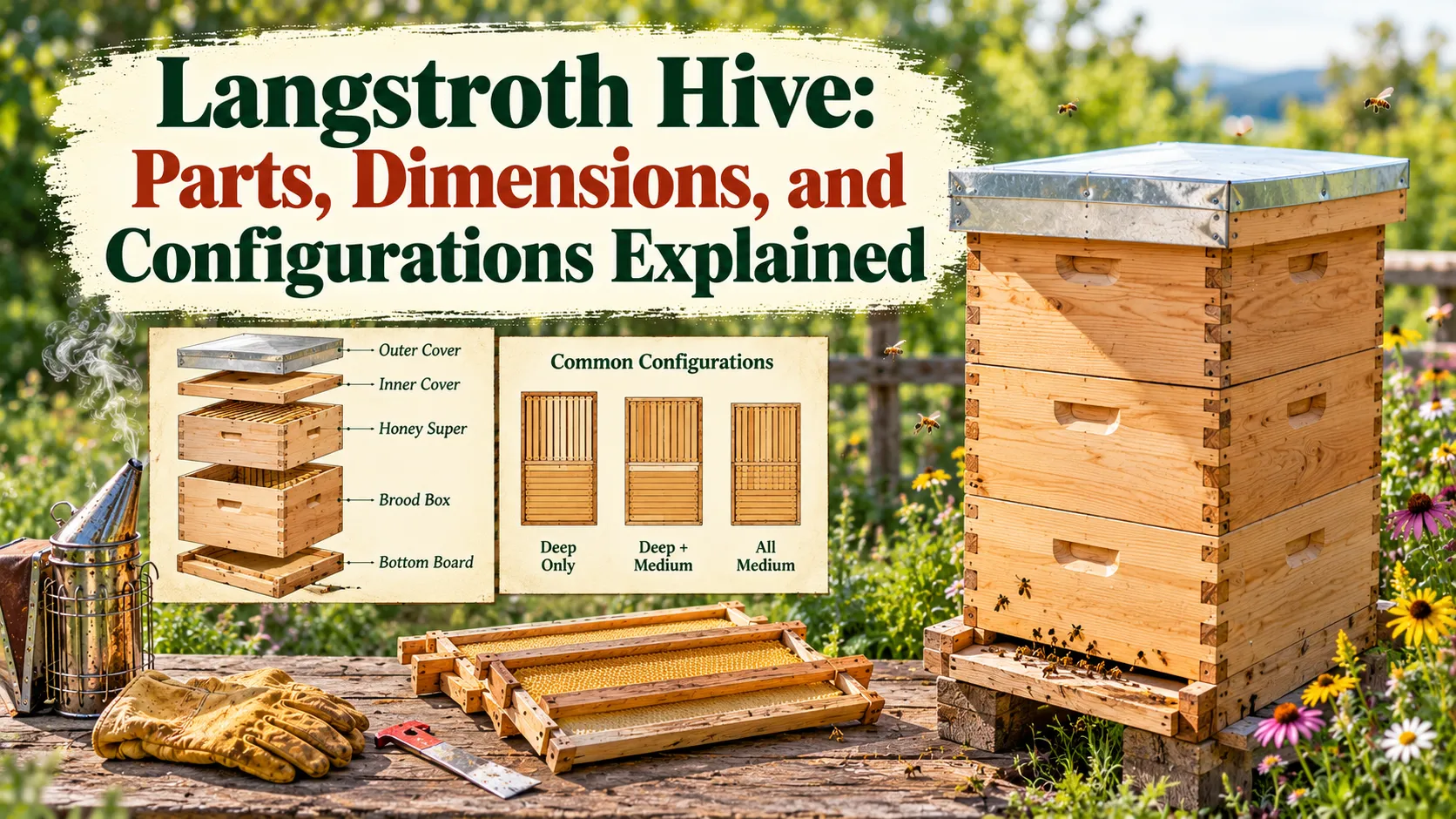
Most beekeeping in the US happens in Langstroth hives. Classes teach on them, nucs are sold on their frames, and almost every piece of equipment is made to fit them. If you’re new, that makes it the default choice. To get the most from it, though, you need to understand the sizes and configurations, because mixing them up is one of the most common beginner mistakes.
This guide covers the dimensions, the box sizes and what each is for, 8-frame vs 10-frame, common setups for beginners, and whether to build or buy. If you’re still choosing between hive types, start with our comparison of beehive types.
What is a Langstroth hive?
The Langstroth hive is named after Rev. Lorenzo Langstroth, an American beekeeper who designed it in 1851 and patented it in 1852. According to Arkansas Extension, his breakthrough was recognizing bee space. When every gap inside a hive is between about 1/4 and 3/8 inch, bees neither fill it with comb nor glue it shut with propolis. Texas A&M puts it at between 6 and 9 millimeters.
Bee space lets each frame hang freely in its box, so you can lift any frame out, inspect it, and put it back without tearing comb. That’s what made modern beekeeping possible: inspecting for disease, checking the queen, and harvesting honey without destroying the nest. Arkansas Extension describes the Langstroth as the worldwide standard for practical beekeeping and commercial honey production.
Parts of a Langstroth hive
From the ground up, a typical Langstroth hive has:
- Hive stand, to raise the hive off damp ground
- Bottom board, solid or screened, with the entrance at the front
- Entrance reducer, for small colonies and cold weather
- Brood boxes (hive bodies), where the queen lays and the colony lives
- Queen excluder (optional), which keeps the queen out of the honey supers
- Honey supers, where bees store surplus honey
- Frames with foundation inside every box
- Inner cover, which Texas A&M calls essential: without it, bees glue the outer cover down
- Outer (telescoping) cover, the weatherproof roof
For a labeled diagram and what each part does, see our guide to parts of a beehive. Our beginner gear guide explains which parts you need before your bees arrive.
Langstroth hive dimensions
Box depths are standard across US manufacturers. Outside widths and lengths vary slightly with wood thickness, so check a specific maker’s specs if you’re building or mixing brands.
Box dimensions
| Box | Depth | Outside, 10-frame (W × L) | Outside, 8-frame (W × L) |
|---|---|---|---|
| Deep (hive body) | 9 5/8 in (24.4 cm) | 16 1/4 × 19 7/8 in (41.3 × 50.5 cm) | 14 × 19 7/8 in (35.6 × 50.5 cm) |
| Medium | 6 5/8 in (16.8 cm) | Same as deep | Same as deep |
| Shallow | 5 11/16 in (14.4 cm) | Same as deep | Same as deep |
The 10-frame dimensions come from the University of Missouri Extension, and the 8-frame width from manufacturer specs. Mississippi State Extension gives the inside of a 10-frame box as 18 3/8 by 14 3/4 inches (47 × 37 cm). Some makers differ slightly. Betterbee, for example, lists its 10-frame deep at 9 1/2 inches high.
Frame dimensions
| Frame | Height | Fits box |
|---|---|---|
| Deep | 9 1/8 in (23.2 cm) | Deep, 9 5/8 in |
| Medium | 6 1/4 in (15.9 cm) | Medium, 6 5/8 in |
| Shallow | 5 3/8 in (13.7 cm) | Shallow, 5 11/16 in |
Frame heights come from Betterbee’s and Dadant’s frame listings. All three sizes share the same top bar length (about 19 inches), so they hang on the same ledge in 8-frame and 10-frame boxes alike.
Each frame is about half an inch shorter than its box, which leaves bee space above and below. Always match frames to boxes. Texas A&M warns that a medium frame in a deep box leaves a gap the bees fill with burr comb.
Box sizes: deep vs medium vs shallow
| Box | Typical use | Approximate weight when full |
|---|---|---|
| Deep | Brood chamber | Over 70 pounds |
| Medium | Brood or honey | About 50 pounds |
| Shallow | Honey super | About 40 pounds |
The weights come from Mississippi State Extension, and they’re for full boxes of capped honey. Mississippi State notes that a full deep is too heavy to move easily, so deeps are generally not used for honey storage.
What is a brood box?
A brood box (or hive body) is the box where the queen lays eggs and the colony raises its young. It’s usually the bottom box, or the bottom two. Texas A&M notes that deeps are usually used as brood boxes because they give the queen the most room to lay. Any box placed above the brood boxes is called a super, whether it’s a deep, medium, or shallow.
8-frame vs 10-frame Langstroth
Both widths use the same frames. The difference is how many fit in a box:
- 8-frame boxes are narrower and lighter. UGA recommends them for beginners, and Mississippi State notes they appeal to anyone who prefers lighter lifts.
- 10-frame boxes are the traditional US standard. They hold more per box, so you need fewer boxes.
What you can and can’t mix, according to Mississippi State Extension:
- Frames move freely between 8-frame and 10-frame boxes.
- Boxes, covers, inner covers, and bottom boards don’t fit each other. You can’t stack an 8-frame box on a 10-frame box.
Mississippi State recommends new beekeepers commit to one size until they have experience. That’s good advice.
Common configurations for beginners
How you stack the boxes is a personal choice. Texas A&M stresses that no two beekeepers do it the same way. These are the most common setups:
| Configuration | Brood area | Heaviest lift | Frames interchangeable? | Suits |
|---|---|---|---|---|
| Two deeps (+ medium or shallow supers) | Two deeps | Over 70 lb | Only within each size | The traditional setup; cold climates; fits deep nucs directly |
| One deep + one medium (+ supers) | One deep plus one medium | Over 70 lb (the deep) | Partly | A middle ground; still takes a deep nuc |
| All mediums | Three mediums | About 50 lb | Yes, every frame fits every box | Anyone who wants lighter lifting and simpler equipment |
| 8-frame boxes (any of the above) | Same layouts, narrower | Lighter than 10-frame | Within each size | Beginners, smaller beekeepers, bad backs |
Mississippi State notes that three medium boxes hold about the same volume as two deeps. If you start with a standard deep nuc and want all-medium equipment, you’ll need to move the nuc frames up into mediums gradually, or start with a package.
When to add the next box: Texas A&M recommends waiting until the bees have filled at least 80 percent of the frames, or drawn comb on 8 of 10. Many beekeepers use a similar 7-of-10 rule. Adding space too early makes the hive harder to keep warm, and adding it too late can lead to swarming.
Langstroth pros and cons
Pros:
- Standard, interchangeable parts available everywhere
- The easiest honey harvest: frames go in an extractor and the empty comb goes back to the bees
- Modular, so it grows and shrinks with the colony
- Compatible with nucs, and taught by most mentors and classes
Cons:
- Heavy lifting. Full deeps weigh over 70 pounds.
- Inspections mean lifting boxes off the colony, which is more disruptive.
- In cold climates, insulation and ventilation need planning. See our cold-weather beekeeping guide.
Compared with horizontal top bar hives and Warré hives, the Langstroth produces more honey and has far better support, but it’s harder on your back. Our comparison of hive types covers the alternatives side by side. The Flow Hive is also a Langstroth at heart: a standard brood box with a special honey super.
Long (horizontal) Langstroth hives
A long Langstroth is a single horizontal box that holds standard Langstroth deep frames side by side, often 30 or more. Instead of stacking boxes, you move a divider board to give the colony more room.
- Pros: no box lifting, standard frames, accepts a standard deep nuc, and frames move freely to and from regular Langstroth hives.
- Cons: you can’t add capacity by stacking, the hive is heavy and hard to move, and honey storage is limited to the length of the box unless you add supers.
It’s a good option for beekeepers who can’t lift heavy boxes but want standard equipment.
Build or buy?
Is it cheaper to build your own beehive? Sometimes. Boxes, bottom boards, and covers are simple woodworking projects if you have a table saw and inexpensive lumber. Frames are harder: they need precise dimensions, and small errors break bee space. Many beekeepers who build their own boxes still buy frames.
Arkansas Extension stresses that box and frame dimensions must be precise for the parts to fit and keep bee space. If you build, work from a published plan, and check your boxes against a commercial one.
For most beginners, buying is simpler. An unassembled kit is the budget option, and assembled boxes save time. Our startup budget guide has current prices.
Buying a Langstroth hive: kit or parts?
A kit gives you matched parts in one order, but check what’s included. Many “complete” kits include only one brood box, no feeder, and no second box, which most colonies need within the first two months. Before you buy, decide:
- Width: 8-frame or 10-frame
- Configuration: two deeps, deep plus mediums, or all mediums
- Assembled or unassembled
- Foundation: plastic (durable, and Texas A&M notes it can be cleaned and reused) or wax
Our beehive starter kits compared guide checks eight Langstroth kits against these choices.
For a step-by-step plan for your first season, see our beginner’s guide to starting beekeeping.
Common questions
What are the different sizes of Langstroth hives?
Langstroth boxes come in two widths, 8-frame and 10-frame, and three depths: deep (9 5/8 in), medium (6 5/8 in), and shallow (5 11/16 in). All share the same 19 7/8 in length. Frames come in matching deep, medium, and shallow sizes.
How heavy is a full deep box?
A deep box full of capped honey can weigh more than 70 pounds, according to Mississippi State Extension. A full medium weighs about 50 pounds and a full shallow about 40, which is why many beekeepers use mediums or shallows for honey.
Can I mix 8-frame and 10-frame boxes?
Not in the same stack. Boxes, covers, and bottom boards don’t fit each other. Frames are interchangeable, though, so you can move frames between 8-frame and 10-frame hives.
How many boxes does a Langstroth hive need?
A new colony starts in one brood box and usually needs a second within the first two months. An established colony typically has two deep brood boxes (or three mediums) plus one or more honey supers in summer.
What happens to a Langstroth hive in fall?
Beekeepers remove empty supers, check honey stores, fit an entrance reducer or mouse guard, and set up ventilation so the colony goes into winter in the boxes it can cover.
Sources and further reading
- University of Missouri Extension, G7600: Beekeeping Tips for Beginners
- Mississippi State University Extension, P3594: Beginning Beekeeping in Mississippi
- Texas A&M AgriLife Extension, ENTO-100: Beekeeping Equipment, Hive Boxes
- University of Arkansas Cooperative Extension, Basic Beekeeping 2: The Bee Hives
- Montana State University Extension, Housing Honey Bees
- Betterbee, Beehive frames: deep, medium, and shallow sizes
- Dadant, Beehive frames (frame and box size matching)
- Premier Bee Products, Pura hive bodies (8-frame and 10-frame dimensions)
- Betterbee, 10-frame deep hive body specifications
- UGA Field Report, A beginner’s guide to successful beekeeping