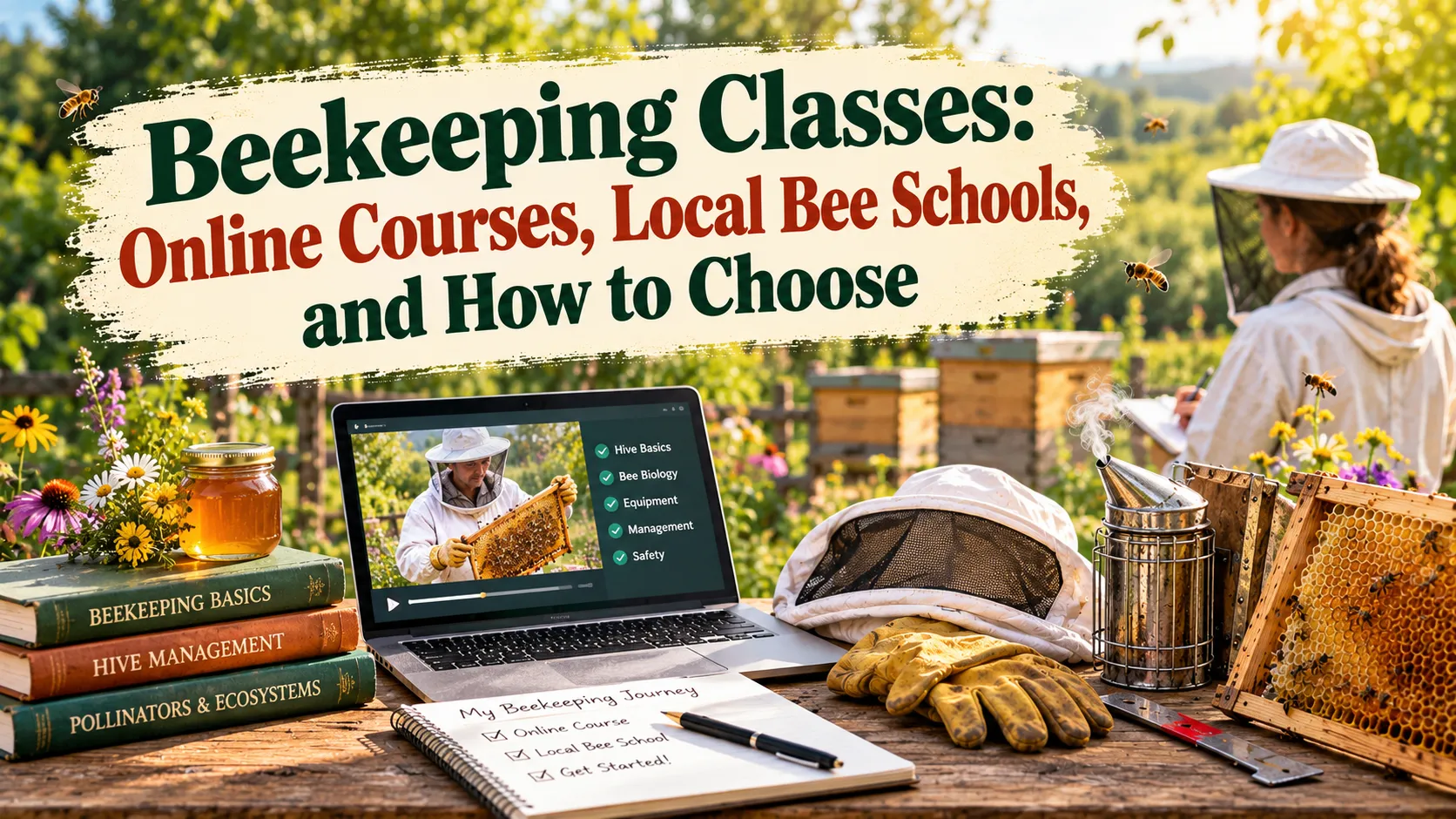
A good beekeeping class saves you from the mistakes that kill most first colonies. It also gets you into a hive before you own one, and connects you with people who keep bees in your climate. Beginner courses vary a lot, though, from a free evening talk to a certificate program costing several hundred dollars.
This guide compares the main types of beekeeping classes, lists notable programs with details we checked in October 2026, and gives you a checklist for judging any course. We haven’t taken these courses ourselves. The details come from each provider’s own listings, and they change every season, so confirm dates and prices before you sign up.
Types of beekeeping classes
| Class type | Format | Typical cost | Hands-on hive time | Best for |
|---|---|---|---|---|
| Local association short course (“bee school”) | In person, 2 to 8 sessions, often with a field day | About $50 to $150 | Often yes, at a club apiary | Most beginners; it builds your local network |
| University or extension online course | Self-paced video modules, sometimes with live Q&A | About $160 to $175 for an intro course | No, unless paired with a field workshop | Busy schedules, rural areas without a club |
| University certificate program | Instructor-led online classes plus assignments | Several hundred dollars | Varies | Beginners who want structured depth |
| Bee supply store class | In person, often a single day | Varies | Sometimes | Quick hands-on intros, often tied to a bee pickup |
| Independent online course | Video course from a beekeeper or company | Varies widely | No | Supplementary learning; check the teacher’s credentials |
The local course ranges come from New Jersey Beekeepers Association branch listings for 2026, which ran from $50 for a recorded class to $150 for multi-day courses with a field day. Prices elsewhere are broadly similar, but check your local club.
Online beekeeping courses worth considering
These programs come from universities and extension services. We checked the details on each provider’s site in October 2026. Prices and registration windows change, so verify before you enroll.
| Program | Provider | Format | Cost (Oct 2026) | Notes |
|---|---|---|---|---|
| Beekeeping 101 | Penn State Extension | Self-paced online, about 9 hours in 10 sections, 365 days of access | $159 | Certificate of completion after a final quiz. Registration was closed when we checked, so watch for the next opening |
| Beekeeping in Northern Climates Online | University of Minnesota Bee Lab and Bee Squad | 14+ hours of recorded modules, monthly live Q&A on Zoom | $175 | Strong on wintering. Pairs with in-person Bee Squad workshops in the Twin Cities |
| Bee-ginner’s Beekeeping: The Basics of Apiculture | Rutgers Office of Continuing Professional Education | Self-paced online, about 14 hours | Not listed on the course page | Offered in set windows (October 2026 was the latest) |
| Beekeeping Essentials Certificate Program | Cornell CALS | Instructor-led virtual classes plus self-paced material | $699 | For beekeepers with 0 to 2 years of experience. Cornell says it meets New Jersey’s education requirement |
If you’re in a cold northern state, the Minnesota course is a good fit because it focuses on getting colonies through long winters. Penn State’s course is a solid general introduction for most of the eastern US.
How to find a beekeeping class near you
Local classes rarely rank well in search results, so go to the source:
- Your state beekeepers association. Most have a page listing local clubs and their beginner courses. New Jersey’s association, for example, lists courses from branches across the state.
- Your county extension office. Extension agents often know the active clubs and may run their own programs.
- Your state apiarist or department of agriculture. Many state apiary programs list clubs and education resources.
- Local bee supply stores. Many host beginner days, especially around package pickup weekends.
- Club “bee school” season. Most clubs run their beginner course from January to March, so start looking in the fall.
What a good beginner beekeeping course should cover
Use this checklist to judge any class, online or in person:
- Bee biology: castes, the colony life cycle, and how a colony behaves through the seasons
- Equipment: hive parts, protective gear, smoker use, and what to buy first
- Getting bees: packages vs nucs, ordering timelines, and installation
- Inspections: what to look for, how to handle frames, and how to keep records
- Varroa mites: how to monitor with an alcohol wash or sugar roll, treatment thresholds, and treatment options. A course that skips mite monitoring is a red flag
- Seasonal management: swarm prevention, feeding, honey supers, and winter preparation
- Pests and diseases: recognizing brood diseases and when to call your state inspector
- Local rules: registration and local ordinances
- Hands-on time: a field day in a real apiary, ideally
- Follow-up support: a mentor program, Q&A sessions, or club membership
When to take a beekeeping class
Most beginner courses run from January to March, so students finish before packages and nucs arrive in April and May. A sensible timeline:
| When | What to do |
|---|---|
| October–December | Find your local club and register for a winter course. Order your bees, since suppliers sell out. |
| January–March | Take the course. Order and assemble your equipment. |
| April–May | Install your bees. Join a field day or mentoring session if your course offers one. |
| Summer | Go to club meetings and ask questions as problems come up. |
Our step-by-step plan for your first beekeeping year covers each stage of that timeline.
Do you need a class to keep bees legally?
In most states, no. New Jersey is an exception. Under the state’s beekeeper registration rule (N.J.A.C. 2:24-3.1), a new beekeeper must take a beginner or general beekeeping course from an accredited college or university, the state apiarist, or a local beekeeping club. It must be completed within one year before or after first registering. Beekeepers registered before May 6, 2019 are exempt. The New Jersey Beekeepers Association says all of its branch beginner courses meet the requirement.
Some towns also set their own conditions. A few New Jersey municipalities, for example, ask for proof of a training course before issuing a local beekeeping license. Check your state department of agriculture and your local code before you get bees.
Class, mentor, or books?
You don’t need to choose just one. They do different jobs:
- A class gives you structure and the basics in the right order.
- A mentor helps with your hive, in your climate, when something goes wrong. Most mentors come from local clubs.
- Books let you go deeper and serve as a reference all season. See our picks of beekeeping books for beginners and beyond.
Most classes ask you to bring your own veil and gloves to field days. Our beekeeping equipment checklist shows what to buy first.
A beekeeping class as a gift
A course registration is a thoughtful gift for someone curious about beekeeping, and the winter timing is ideal, since most courses start in January. Check whether the course allows gift registration or transfers. For more ideas, see our gift guide for beekeepers.
Common questions
How much do beekeeping classes cost?
Local association short courses usually cost about $50 to $150. University online intro courses cost around $160 to $175 (Penn State’s Beekeeping 101 was $159 and Minnesota’s online course $175 in October 2026). Certificate programs cost several hundred dollars.
Are online beekeeping courses worth it?
Yes, for learning the theory in order, especially university courses taught by bee researchers. They can’t replace hands-on time in a hive, so pair one with a local club, a field day, or a mentor.
How long is a beginner beekeeping course?
Local short courses usually run over 2 to 8 sessions, often with a field day. University online courses take about 9 to 14 hours of video, which you can complete at your own pace.
Do I need a certificate to keep bees?
Not in most states. New Jersey requires new beekeepers to complete a beginner course within a year of their first registration, but a certificate program isn’t required. Check your state and local rules.
Where can I find a beekeeping mentor?
Through a local beekeeping club. Many clubs run formal mentor programs for students in their beginner course. Your county extension office can point you to active clubs.
Sources and further reading
- Penn State Extension, Beekeeping 101 (online course)
- University of Minnesota Bee Lab, Beekeeping in Northern Climates Online
- University of Minnesota Bee Lab, Bee Squad Mentoring Apiary
- Rutgers Office of Continuing Professional Education, Beekeeping courses
- Cornell CALS, Beekeeping courses and certifications
- New Jersey Beekeepers Association, Beginner courses
- N.J. Admin. Code § 2:24-3.1, Registration requirements (via Cornell LII)